Join World's Fastest Growing B2B Network
Join World's Fastest Growing B2B Network

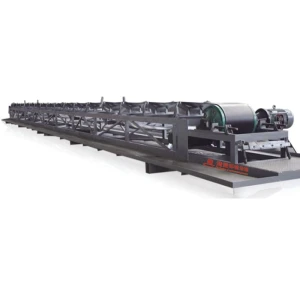


Belt conveyors can transport various bulk materials and packaged items. According to the conveying process requirements, they can be used individually or in combination with other equipment to form a conveying system, achieving continuity and automation to meet different operational needs.
Fixed belt conveyors primarily come in two types: TD75 and DTI. Both of these belt conveyors are of the general-purpose variety, allowing users to select, design, and produce them based on the properties of the conveyed material and the processing requirements due to their wide range of applications. General-purpose fixed belt conveyors primarily consist of tensioning devices, idlers and frames, conveyor belts, cleaning devices, braking devices, tail ends, and head drive devices;
The DTI technology-based fixed belt conveyor is a universal series of products, widely applicable in various industries such as metallurgy, mining, ports, power stations, building materials, chemical, and light industry. It can be used as a single unit or combined with multiple units to form a transportation system for conveying materials. It is capable of conveying various bulk materials with a loose density ranging from 500 to 2500 kg/m³, as well as finished products. The suitable operating ambient temperature range is generally from -25 to +40 degrees Celsius.
In case of special working environments requiring heat and cold resistance, waterproofing, corrosion resistance, explosion-proofing, flame retardancy, or other conditions, corresponding protective measures should be taken
It is characterized by strong conveying capacity, high conveying efficiency, good conveying quality, and low energy consumption, making it widely used. The conveying capacity of a conveyor decreases as its inclination angle increases, so a smaller inclination angle is preferred
One moment please
 Member's Area
 Messages
 Need Help








 Browse Through Millions of High-Quality Products.