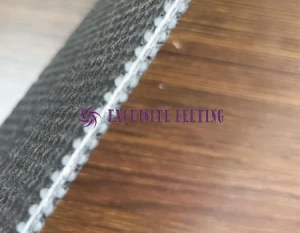
Double-sided saturated PVK
conveyor belts are a special type
of industrial conveyor
belt.
They combine PVK (polyvinyl
butyral) material with specific
processing techniques (such as
double-sided saturated
impregnation).
With their high strength, low
elongation, heat resistance, and
good adhesion, they play a
crucial role in high-end
industrial conveying
systems,
especially in heat treatment and
composite processes where high
precision, stability, and
durability are required.
selection should be based on
specific operating conditions
(temperature, load, speed,
environment).
I.
Characteristics of Double-sided
Saturated PVK Conveyor
Belts
1.
Double-sided Saturation
Treatment:
-
The conveyor belt substrate
(usually fabrics such as
polyester or nylon) is
thoroughly impregnated on
both sides with PVK resin
slurry,
ensuring a tight bond between
the fibers and the
resin.
-
This improves overall
density, enhances tensile
strength, and increases wear
resistance.
2.
Excellent Adhesion
Properties
-
PVK exhibits excellent
adhesion, making it
particularly suitable for
multi-layered composite
structures
or applications requiring
bonding with other materials
(such as rubber or
coatings).
-
It effectively prevents
delamination during
lamination or coating
processes.
3. High
Dimensional
Stability
Double-sided saturation treatment
reduces fabric stretching and
deformation under heat or stress,
ensuring
precise positioning during
operation..
4. Good
Heat Resistance
PVK resin remains stable within a
certain temperature range
(typically operating at
80–120°C), suitable for
medium-temperature
conditions.
5.
Strong Tear and Abrasion
Resistance
Saturated fabric structures are
more robust, able to withstand
frequent friction and material
impacts.
6.
Smooth Surface
The dense surface after slurry
treatment is suitable for
applications requiring high
surface quality, such as
printing, lamination, and
drying.
7. Good
Moisture and Mildew
Resistance
PVK possesses a certain degree of
water resistance and chemical
stability, making it suitable for
use in humid environments.
8. Low
Elongation
Compared to ordinary fabric
belts, the double-sided saturated
structure significantly reduces
tensile deformation and improves
operational stability.
II.
Typical Application
Areas
1.
Paper Industry
-
Used as a dry wire or
conveyor belt in the paper
drying section, especially
suitable for high-speed paper
machines.
-
Double-sided saturated PVK
improves belt strength and
heat resistance, adapting to
high-temperature drying
cylinder environments.
2.
Textile Printing and Dyeing
Industry
3.
Composite Materials and Laminate
Production
-
Used as a pressing belt in
thermoforming processes for
engineered wood panels,
decorative panels, fireproof
boards, etc.
-
PVK's adhesion and heat
resistance help improve
product surface
quality.
4.
Printing and Coating
Industry
-
Used as a support or conveyor
belt in flexographic
printing, gravure printing,
or precision coating
equipment.
-
Especially suitable for
applications requiring high
precision and low
deformation.
5. Food
Processing and Drying
Lines:
Used in some food drying
equipment, provided that PVK
meets food-grade safety
standards
(specific model certification by
the FDA/EC needs to be
confirmed).
6. New
Energy Material
Manufacturing:
For example, conveyor belts used
in lithium battery electrode
coating and drying processes
require cleanliness, temperature
resistance,
and low elongation.
III.
Precautions
-
Temperature Limitations: The
long-term operating
temperature of PVK generally
should not exceed
120°C;
exceeding this temperature
may cause aging or
softening.
-
Chemical Compatibility: Avoid
contact with strong acids,
strong alkalis, or organic
solvents to prevent damage to
the resin structure.
-
High Customization: Fabric
type (e.g., PET/PA),
thickness, width,
and splicing method (jointed
or circular) can be adjusted
according to customer
needs.




 Member's Area
 Messages
  Need Help





 Browse Through Millions of High-Quality Products.